Safety only becomes real
when it is verified.
Inspection and verification services for safety, quality and traceable technical records.
Our Technical Services
In addition to training and technical consulting, SCG provides a range of inspection and verification services.
These services support companies in maintaining safety, quality and legal compliance and complement our practical training and consulting services.
Our services are carried out in accordance with the relevant DGUV regulations and technical standards and are tailored to operational requirements.
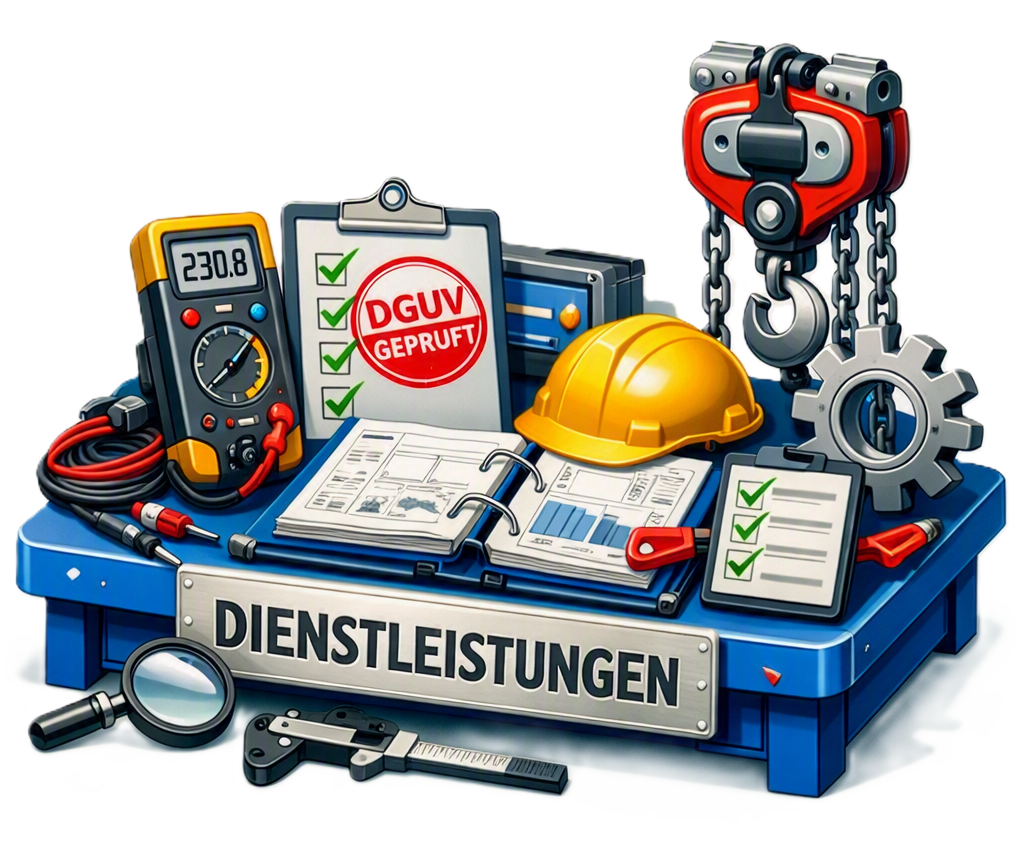
Inspections and Technical Services
From electrical equipment and lifting devices to machinery and additional inspection services.
DGUV Regulation 54
Inspection of winches, lifting and pulling equipment as well as safety-relevant components.
Learn MoreNDT Inspections
Non-destructive testing methods for welding technology, plant engineering and industry.
Learn MoreInspections in Accordance with DGUV Regulation 3
Electrical equipment must be inspected regularly to ensure safety and legal compliance.
We carry out periodic inspections in accordance with DGUV Regulation 3 in a structured, documented and traceable manner.
Services
- Visual inspection
- Functional testing
- Measurements in accordance with DGUV requirements
- Documentation of results
- Inspection reports
Services
- Inspection of lifting equipment
- Inspection of load-bearing equipment
- Assessment of safety-relevant components
- Documentation in accordance with DGUV requirements
Inspections in Accordance with DGUV Regulation 54
Lifting equipment must operate reliably to ensure that loads can be moved safely.
We inspect lifting equipment, wire rope hoists and chain hoists in accordance with DGUV Regulation 54.
Safety-relevant components and load-bearing equipment are inspected, assessed and documented.
Inspections in Accordance with DGUV Rule 100-500
Identify hazards before they become a safety risk.
Machinery must be inspected regularly to identify safety-related defects and hazards at an early stage.
Our inspections particularly complement SCG training in the field of machine operation and enable comprehensive technical support.
Services
- Visual inspection
- Functional testing
- Safety-related checks
- Documentation of results
Non-Destructive Testing (NDT)
Non-destructive testing is particularly relevant for welding technology, plant engineering and industrial applications.
Depending on customer requirements, various non-destructive testing methods can be provided without damaging the component during inspection.
VT
Visual Testing
Visual inspection and assessment of accessible
surfaces and welded joints.
PT
Penetrant Testing
Testing method for detecting
surface-breaking discontinuities.
MT
Magnetic Particle Testing
Testing method for suitable
ferromagnetic materials and components.
Added value: Quality assurance for critical components and welded joints.
Additional Technical Services
Depending on customer requirements, our service portfolio can be expanded to include additional technical inspection and support services.
Additional Inspection Services
- Inspection of lifting accessories
- Inspection of personal protective equipment (PPE)
- Inspection of ladders and steps
Technical Support
- Machine acceptance after modifications
- Support during commissioning
- Integration of Gärttner Group’s technical expertise
Train. Advise. Inspect.
Combining our different areas of expertise enables us to provide comprehensive technical support.
01 · Train
Provide employees with practical qualifications for the safe use of machinery and work equipment.
02 · Advise
Address technical and safety-related issues together with the customer.
03 · Inspect
Inspect machinery, work equipment and technical components and document the results in a clear and traceable manner.
Inspections provide clarity.
Regular inspections help identify hazards at an early stage and provide traceable documentation of the safe condition of machinery, installations and work equipment.
The type and scope of each inspection service are tailored to the technical requirements and operational conditions.